You post a long update in Slack. You've put real thought into it, the context, the reasoning behind a decision, a few bullet points laying out what happens next. And it just sits there. No reply. No thumbs up. Nothing.
You start wondering if anyone actually reads these. Maybe next time you keep it shorter. Maybe you stop bothering with the detail at all.
Nobody on your team ever agreed on how a message like that gets acknowledged. Whether a reaction is enough, whether it needs a reply, or whether silence just means "seen, all good". You assumed one thing. Everyone else assumed another. That gap is where the resentment starts, quietly, over weeks.
This is exactly the pattern Gustavo Razzetti writes about in his newsletter, Demystify Culture. Conflict rarely starts with one big event. It starts with agreements nobody actually made, and the small stories people tell themselves when those unwritten expectations get broken.
The golden rule is wrong
Gustavo's point is that we default to treating people how we'd want to be treated. But everyone's expectations are different. One person treats a long Slack message as a reference doc they'll come back to. Another sees a wall of text and mentally files it under "later", which quietly becomes "never". Neither is wrong. Nobody wrote it down.
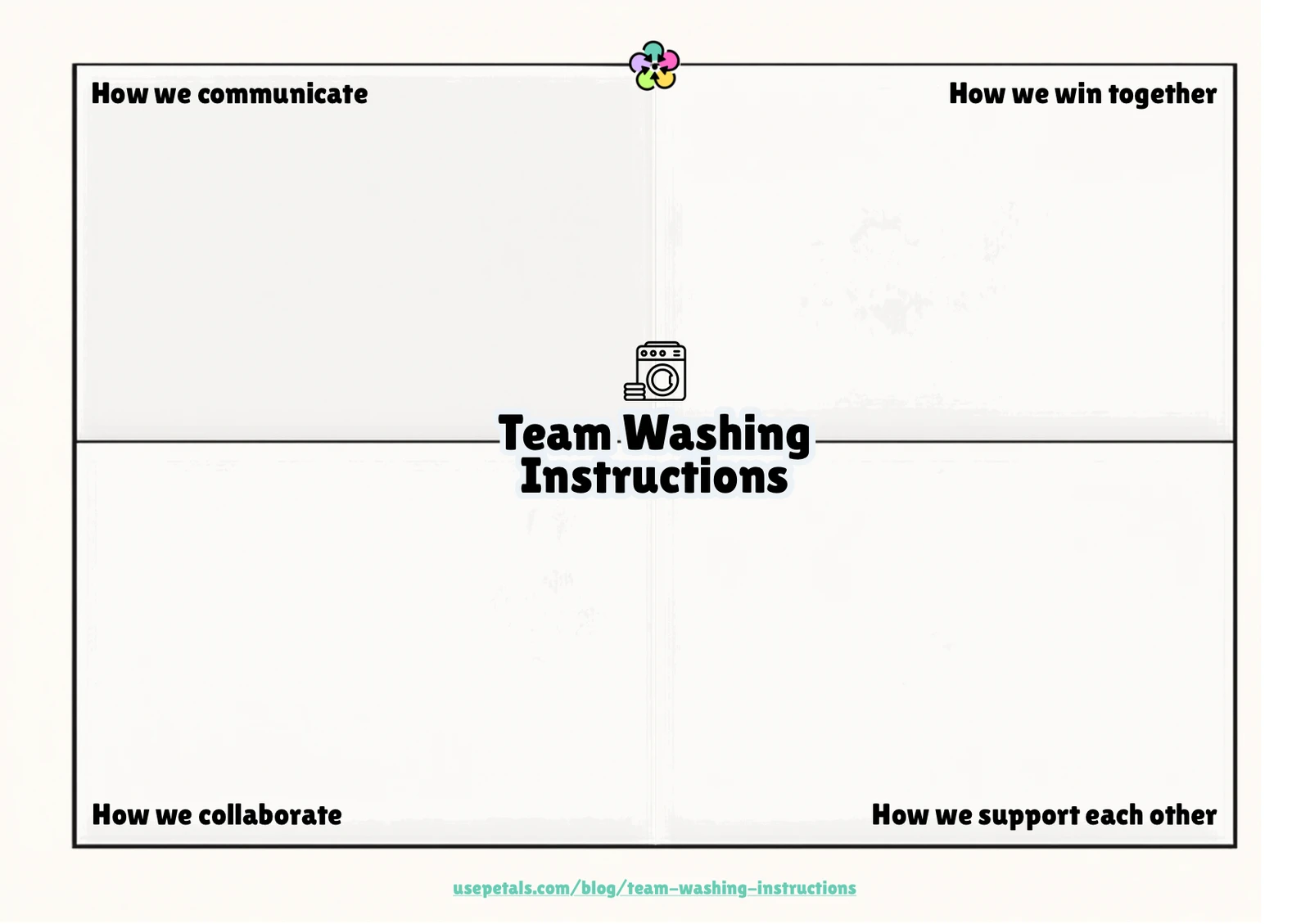
His fix is the Team Washing Instructions Canvas, a simple worksheet split into four areas:
- How we communicate, which channel carries which kind of message, and what response people can actually expect
- How we collaborate, when and where people work, and how the team handles async versus sync
- How we win together, what good work looks like, and how mistakes get handled
- How we support each other, recognition, feedback, and what's non-negotiable
Filled in properly, it turns a hundred small unspoken assumptions into something the team actually agreed on. Worth reading his full piece if you haven't already, it's where this idea comes from, including the template.
Where PETALS fits
Washing instructions are the agreement. PETALS is the pulse check on whether that agreement is actually landing.
They're not doing the same job. One is a conversation about the rules of engagement, done properly maybe once a quarter. The other is a quick, regular read on how the team is feeling, week to week, against those rules. Neither one replaces the other. A washing instructions canvas nobody revisits goes stale. A PETALS snapshot with no shared agreement behind it just tells you something's off, not why.
Use it to calibrate a new team
When a team first forms, or after a reshuffle, run the washing instructions canvas before the first PETALS snapshot. It gives everyone a shared starting point instead of each person guessing what "responsive" or "supportive" means. And it gives that first snapshot something concrete to measure against, rather than five vague feeling factors floating with no context.
Use it to reset a conversation that's gone flat
If your PETALS snapshots start feeling repetitive, same scores, same shrug, nobody's got much to add, that's usually not a sign the team's fine. It's a sign the "how we work" conversation has gone stale. Treat a flat or low-effort snapshot as your cue to pull the washing instructions canvas back out. Ask what's working, what needs clarifying, what's missing. Refresh the agreement, then pick the snapshots back up.
That Slack message nobody reacted to is a good example. If Teamwork or Serenity keeps dipping and nobody can say why, "how we communicate" is often the quadrant worth revisiting first.
A simple rhythm
Revisit the washing instructions canvas quarterly, or whenever the team changes shape. Run PETALS snapshots regularly in between. If one factor keeps coming back low, that's your signal for which quadrant needs another look.
Agreements without a pulse check go stale without anyone noticing. A pulse check without agreements tells you something's wrong but not why. Use both.
We've put together a PETALS-themed version of the washing instructions canvas, the same four quadrants, with our flower mark sitting at the centre as the reminder.
Download the printable canvas and run it with your team, then try a PETALS snapshot and see what conversation it starts.