Quick one from this week's dev time with Brian.
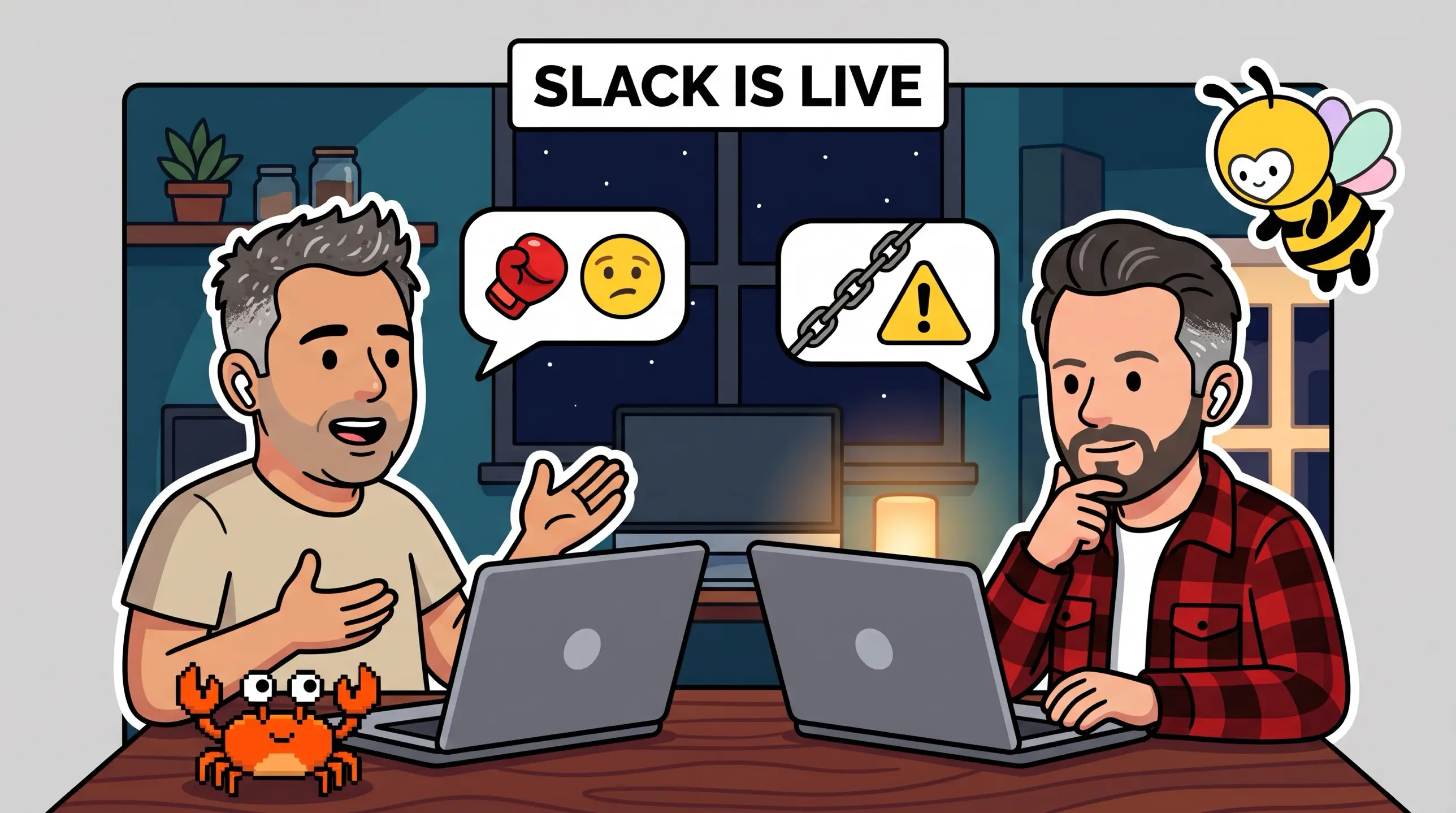
Slack is live
The Slack work we've been chatting through the last few dev times has actually shipped. Teams can connect their Slack workspace, pick a channel, and get notified when a snapshot opens or closes. We're easing it in, a few people are using it as a beta right now, and we're tidying up the smaller edge cases (what happens on disconnect, who needs admin rights, that sort of thing) before we open it up properly.
Shipping fast without pretending it's finished
A chunk of this week's chat wasn't really about PETALS at all, it was about how we build things in general. Si's rule of thumb:
"Don't look at the quality, look at the risks. It's not necessarily what you're building or how you're building it, it's what risks are you introducing by doing that. That's what you need to worry about from a testing perspective."
An internal tool that might get thrown away in two months doesn't need the same rigour as something customers are paying for, because the risk it carries is completely different. The goal with anything new is just to get from A to B, see if the idea actually holds up, then worry about making it nice. Or, as it got put on the call: "I'd be disappointed if it's not thrown away the first time."
That's basically how PETALS itself started too: try a load of stuff, see what sticks, then go back and build properly on the bits that clearly work. It's also a good moment to be honest about which "agile" habits are actually agile. Plenty of teams run a sprint ceremony every week and still ship everything in one big batch at the end, which is waterfall with a stand-up bolted on.
Brian's line for this one: he always comes back to the Mike Tyson quote, everyone's got a plan until they get punched in the face. You put the idea out in the world, someone says "that's not compliant, you need a signature," and that's how you find out what you actually needed all along.
Asking Claude for a second opinion on our own app
My go-to way of beating designer's block at the moment: hand Claude the whole codebase and docs, and ask it to redesign a flow from scratch with no context on why anything looks the way it currently does. It's not the final answer, but it's a genuinely useful "what would a stranger do with this" perspective, and it's already changed how we're thinking about simplifying the core snapshot journey.
There's a flip side worth a mention too: the more AI-built interfaces you see, the easier the tells get. The shouty all-caps labels, the heavy rounded corners, a certain shade of gradient. We joked about "Claude smell" rather than code smell. Most users don't actually care how a screen got made, though. They care whether it works.
What's still ours when Claude can build it
The honest question we keep circling back to: if someone can describe PETALS to Claude and get a rough version of it in an afternoon, what exactly are people paying us for? We don't think it's the code. It's the boring-to-rebuild stuff: a UI that's actually been battle-tested, the edge cases we've already hit and fixed, someone to email when something breaks, and the fact we're not going anywhere. AI makes a first version of almost anything cheap. It doesn't make the maintenance, the trust, or the support cheap, and that's where we reckon the real product still lives.
There's a sharper version of that point too, specific to what PETALS actually measures. Claude can write the code, but it doesn't care whether any of it actually makes a team feel better. It's not drawing on having felt that itself, just on a huge amount of text about what feelings tend to look like from the outside. We care, because we've felt the thing we're trying to measure, and that's what keeps us iterating on it until people genuinely feel the benefit, not just until a feature ships. Good luck simulating that with an LLM.
A free survey for the new year
We want to put something out at the start of the year that isn't a sales pitch, a short, free survey about team health in general, not PETALS specifically. A handful of questions about you and your organisation, then a longer set about how (or whether) you run team health at all. It'll stay open from New Year through to Valentine's Day, and we'll publish the anonymised results as a proper look at the state of the industry, whether people use PETALS or something else entirely.
The idea is to give something back to the wider team health framework, not just plug our own product.
If there's something you'd like to see, or something that's not working how you'd expect, reply to any PETALS email and it comes straight to us.