Another one from Gustavo Razzetti landed in my inbox this week, Conversations Are Your Team's Most Important Operating System, and it's a neat way of sorting out what a team is actually trying to do when it sits down to talk.
His framing is two questions. Is the conversation about the work or about people? And is the purpose to put differences to work or to find common ground? Cross them over and you get four conversations:
| Differences | Common ground | |
|---|---|---|
| Work | Think: make ideas stronger before anyone judges them | Decide: disagree, then everyone commits |
| People | Connect: get curious about the person behind the role | Collaborate: agree how we work together |
The bit that made me stop was his ordering. Teams, he says, rush to common ground before exploring their differences, and miss what makes collective intelligence possible. Differences come first, common ground comes next.
That's close to the opposite of how a lot of our best PETALS conversations go. We tend to start with the common ground in the scores, and only then dig into the differences. So who's right?
I think both, and the deciding factor is psychological safety.
The heatmap is already a 2x2
A PETALS heatmap has the same two axes built in, if you know where to look.
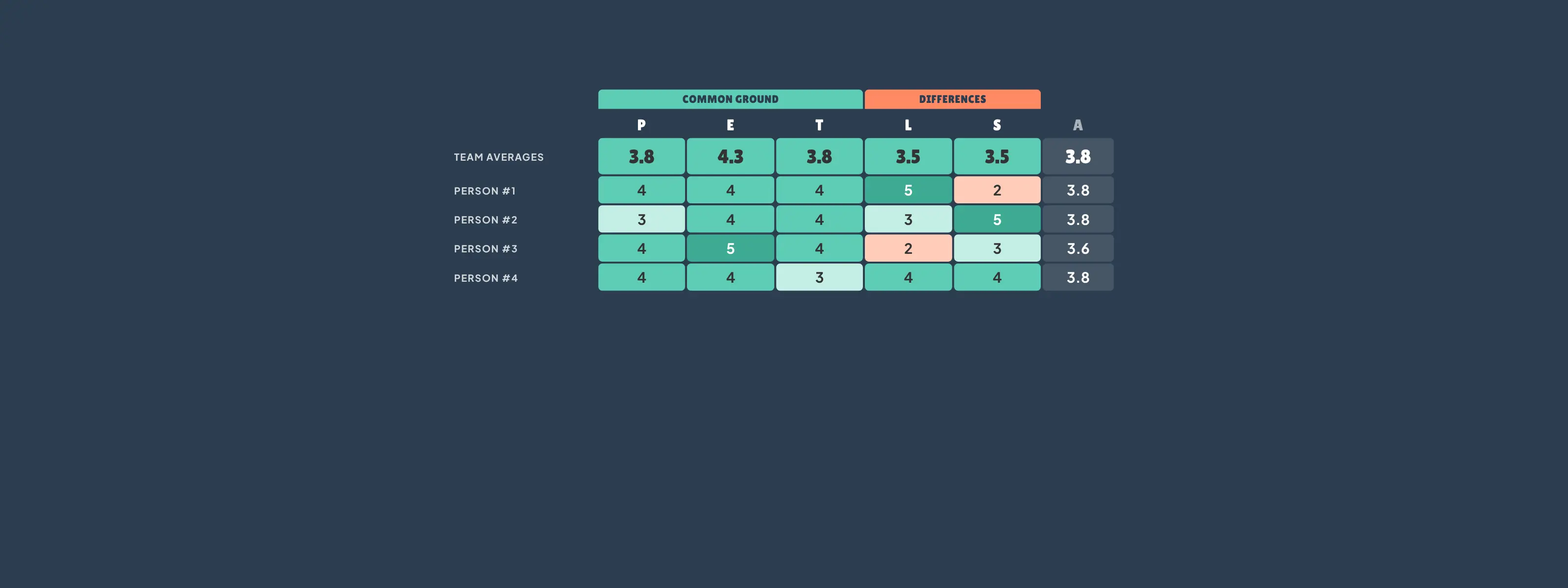
An example team, made up for illustration.
- Work or people. Productivity and Learning lean towards the work. Enjoyment, Teamwork and Serenity lean towards the people. It's not a hard line, but it's a handy way to hold the grid.
- Common ground or differences. Look at how tight or spread each column is. Teamwork here is 4, 4, 4, 3, which is common ground. Serenity is 2, 5, 3, 4, which is a difference.
Put the two together and every column of the grid points at one of Gustavo's four conversations. Productivity is a Decide conversation. Enjoyment and Teamwork are Collaborate. Learning is Think, and Serenity is Connect.
One thing worth noticing: Learning and Serenity both have a team average of 3.5. The average looks unremarkable, but it hides a 5 and a 2 in the same column. Averages tell you where the team is, the spread tells you what the conversation is.
Same grid, two very different rooms
Imagine this exact heatmap belonging to two different teams.
🌿 Team Fern has high psychological safety. People disagree with their lead in meetings, mistakes get talked about, and nobody is surprised when someone says "I don't see it that way".
🪨 Team Slate has low psychological safety. Meetings are polite, the loudest voice tends to win, and speaking up about problems has gone quietly out of fashion.
Fern can go straight to the differences
Fern opens the heatmap and heads for Serenity. Someone says "I scored that a 2, and here's why", and the rest of the team gets curious rather than defensive. Someone else says they gave it a 5 and explains what's working for them. That's Gustavo's Connect conversation doing its job, and the team learns something it didn't know about itself.
For Fern, starting with common ground would probably be a slightly dull warm-up. They don't need the safety building, so the article's order works fine.
Slate needs the common ground first
Now put Slate in the same room, looking at the same column. The first conversation is about a 2 sitting in the middle of the grid, with a person's name attached to it, or at least a guess at who it is. Nobody wants to be that person. What Gustavo calls a competitive conversation starts quickly: people defend their scores, or play them down, or go quiet.
His own question helps here: "are we trying to find the best path, or trying to win?" On a team without much safety, opening with differences makes it very easy to slip into winning.
So Slate starts somewhere else. It looks at Enjoyment, where everyone is a 4 or 5. It looks at Teamwork, where the team agrees it's solid. These are cheap, low-risk conversations, and they do two things at once. They remind the team it's on the same side, and they let people practise saying true things out loud and having them land well. That's the safe space, built a bit at a time.
Only then does Slate move on to Learning and Serenity. By that point the 2 is a thing the team looks at together, rather than a thing someone has to defend.
A quick way to judge which room you're in
You don't need a formal assessment. A few signals are enough to get started:
- When someone scores low, do others get curious, or does the room go quiet?
- Do people disagree with the team lead out loud?
- Are written comments specific and honest, or short and safe?
- Can the team talk about the last thing that went wrong without it turning into blame?
If most of those are a yes, lean towards Gustavo's order. If most are a no, start with common ground and treat it as an investment, not a detour. Most teams are somewhere in the middle, so it helps to read the room as you go and be ready to change order. If a differences conversation starts to feel like a contest, step back to common ground and come at it again.
Differences are how teams help each other
The reason to get to differences at all isn't to find out who's right. A spread in a column is also a list of who has something to teach. The person who scored Serenity a 5 probably has a habit or a boundary the rest of the team could borrow. The person who scored Learning a 2 might be the one who has noticed a gap everyone else has stopped seeing.
That's the point where a heatmap stops being a report card and starts being a way for a team to help itself.
The actions come from the conversation
Which brings us to the actions. A list of improvements written by whoever ran the snapshot is easy to ignore. Actions that come out of the conversation tend to stick, because the people who'll do them helped shape them. That's Gustavo's "disagree and commit" in practice: people get to challenge the idea while the discussion's still open, then everyone commits.
A simple shape that works for most teams:
- Start with common ground. Name what the team agrees on, in both the work and the people columns.
- Move to the differences. Pick one or two spread-out columns, and ask what each person is seeing.
- Look for who can help. Treat the high scores as something to share, not just the low ones as a problem.
- Finish on common ground again. Agree one or two actions, who owns them, and when you'll look again.
The next snapshot will show whether they worked. Then the heatmap starts the next conversation.
If you want to go deeper on the safety side of this, we've written before about conversational debt and how team size changes who speaks. Both are really about the same thing: the better the conversation, the better the data and the actions that follow.
This is the kind of thing our newsletter subscribers hear about first. If you'd rather get product updates and insights like this straight in your inbox instead of waiting for the blog, subscribe below.